


How to Choose the Right Steel for a Plastic Injection Mold
When launching a plastic injection molding project, buyers typically focus on mold pricing, cavity count, expected output and lead time. Even so, one critical factor shapes long-term mold performance: the mold steel selected for cavity and core fabrication.
Mold steel directly determines wear resistance, corrosion resistance, polishing potential, machinability and ongoing maintenance workload. Mismatched steel selection for your resin or production environment can lead to premature cavity wear, degraded surface quality, frequent repairs and unnecessary tooling expenses.
For instance, a mold for standard ABS or PP housings does not demand the same steel specification as a mold built for glass-filled engineering plastics or high-clarity cosmetic parts.
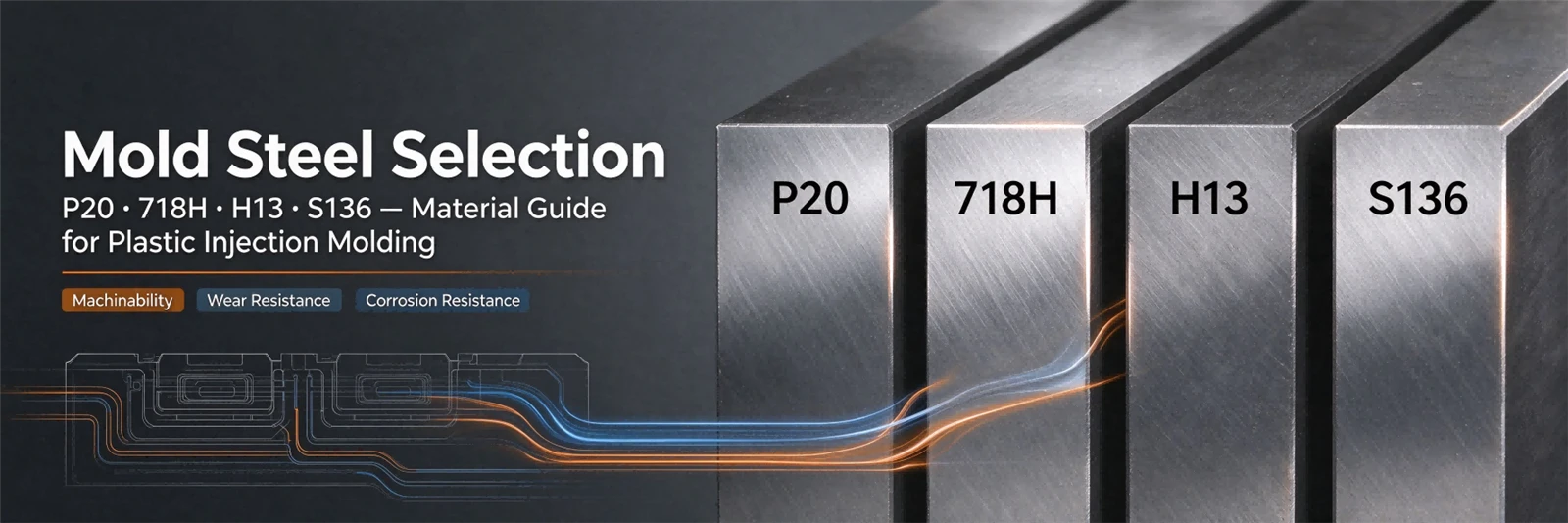
This article breaks down four mainstream injection mold steel grades - P20, 718H, H13 and S136 - and guides you to match steel options to your actual project requirements.
1. Why Does Mold Steel Selection Matter?
An injection mold cycles under repeated mechanical clamping, thermal fluctuation and chemical exposure throughout production.
Each molding cycle includes these steps:
- Mold closing and clamping
- Molten plastic injection into the cavity
- Packing and cooling
- Mold opening and part ejection
Over tens of thousands to hundreds of thousands of shots, gates, slides and shut-off surfaces endure friction, high pressure, temperature cycling, resin-induced corrosion and abrasive wear.
The selected steel must satisfy your project's core performance targets.
| Mold requirement | Why it matters |
| Hardness | Resists indentation and surface deformation |
| Wear resistance | Reduces damage from repeated movement and abrasive fillers |
| Corrosion resistance | Protects cavity surfaces and cooling channels from chemical attack |
| Polishability | Governs achievable surface finish, from texture to mirror polish |
| Toughness | Prevents cracking under cyclic mechanical load |
| Machinability | Cuts down CNC machining time, fabrication complexity and mold cost |
No single steel grade excels in every category. The optimal choice balances these properties for your specific application.
2. Comparing Four Common Mold Steel Grades
P20
A General-Purpose Pre-Hardened Mold Steel
P20 is a widely adopted pre-hardened plastic mold steel.
It is the go-to option for general injection molding jobs where fast machining and controlled tooling cost are priorities.
Advantages
- Excellent machinability in its as-delivered pre-hardened state
- Compatible with most conventional mold structures
- Eliminates the need for secondary hardening in many projects
- Cost-effective for general tooling
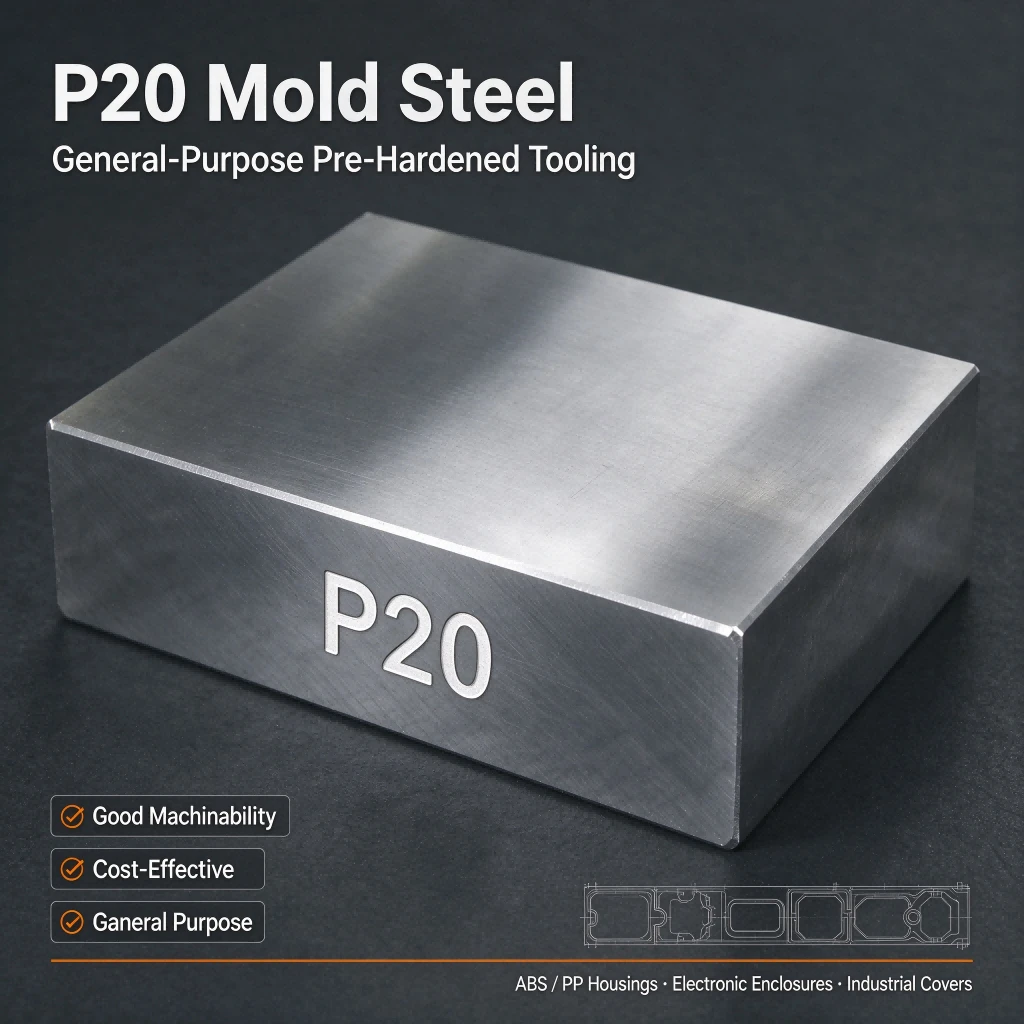
Typical applications
- ABS plastic housings
- PP household articles
- Standard electronic enclosures
- Industrial plastic covers
- Medium-complexity molded parts
Limitations
P20 is not suitable for heavy-wear, highly corrosive or premium mirror-polish applications. Final performance depends on steel purity, heat treatment and surface preparation.
718H
Modified Pre-Hardened Mold Steel for Larger Tools
718H is a modified P20-family pre-hardened mold steel, though exact material equivalence varies by steel mill.
It is preferred for large molds requiring consistent internal material quality and stable surface finish.
Advantages
- Supplied pre-hardened to streamline mold manufacturing
- Well suited for large mold bases and cavity blocks
- Balances good machinability and reliable mold performance
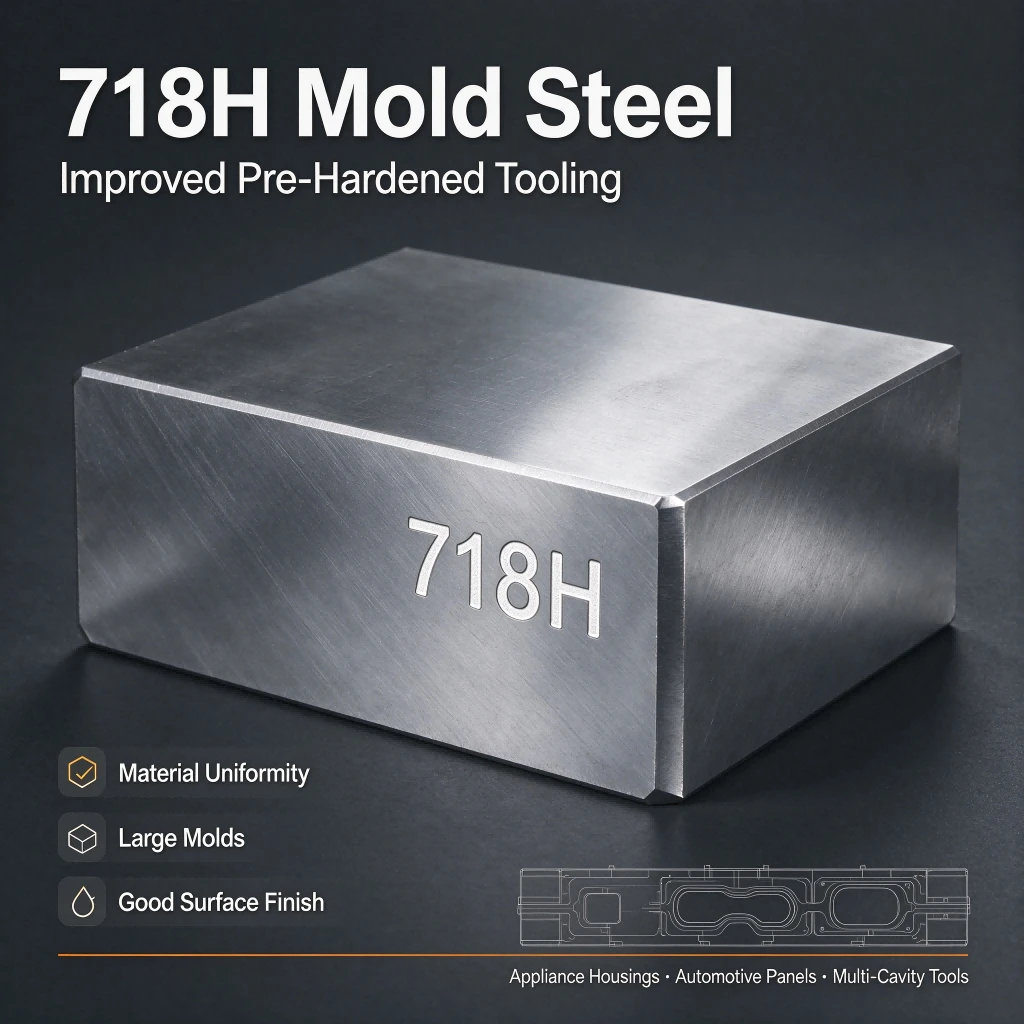
Typical applications:
- Large appliance housings
- Automotive plastic trim panels
- Electronic equipment enclosures
- Multi-cavity large mold assemblies
- General industrial plastic components
Limitations
The designation "718H" alone does not guarantee fixed material properties. Buyers should verify the mill standard, delivery hardness, material COC and special requirements for cavities and cores.
H13
Hot-Work Tool Steel for High-Demand, Abrasive Jobs
H13 is a chromium-molybdenum-vanadium hot-work tool steel famous for stable hot hardness, high toughness and strong wear resistance.
BÖHLER classifies its W302 grade as equivalent to material number 1.2344 / AISI H13, listing injection molding among its qualified use cases.
Advantages
- Outstanding hot hardness and thermal toughness
- High resistance to abrasive wear
- Proven for heavy-duty tooling
- Works for injection molding and other hot-forming applications
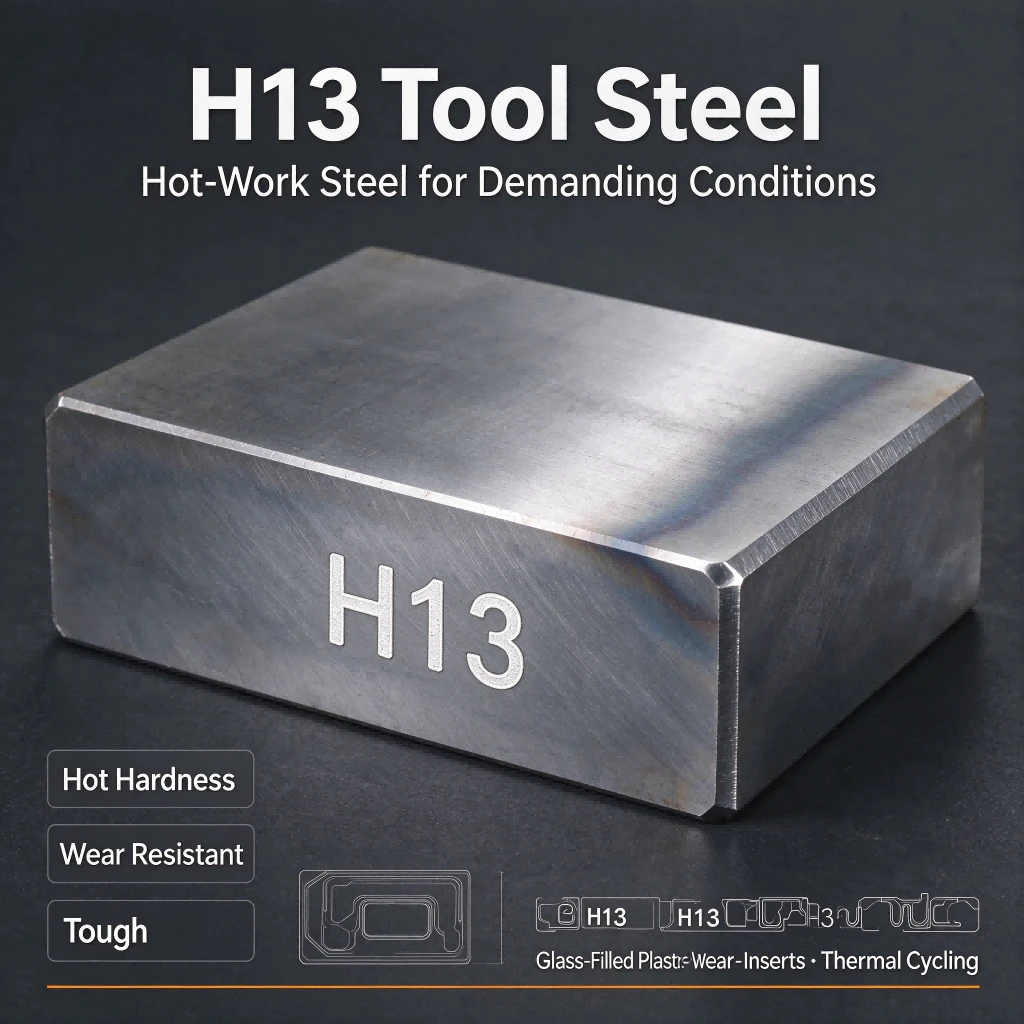
Typical applications:
- Molds operating under severe thermal cycling
- Wear-prone mold inserts
- Selected glass-fiber-reinforced plastic projects
- Parts requiring superior abrasion resistance
Limitations
H13 requires tightly controlled heat treatment when full hardening is specified. Mold designers must account for heat-treatment distortion, post-hardening machining and polishing allowance up front.
S136
Stainless Mold Steel for Corrosion Resistance & High-Gloss Polish
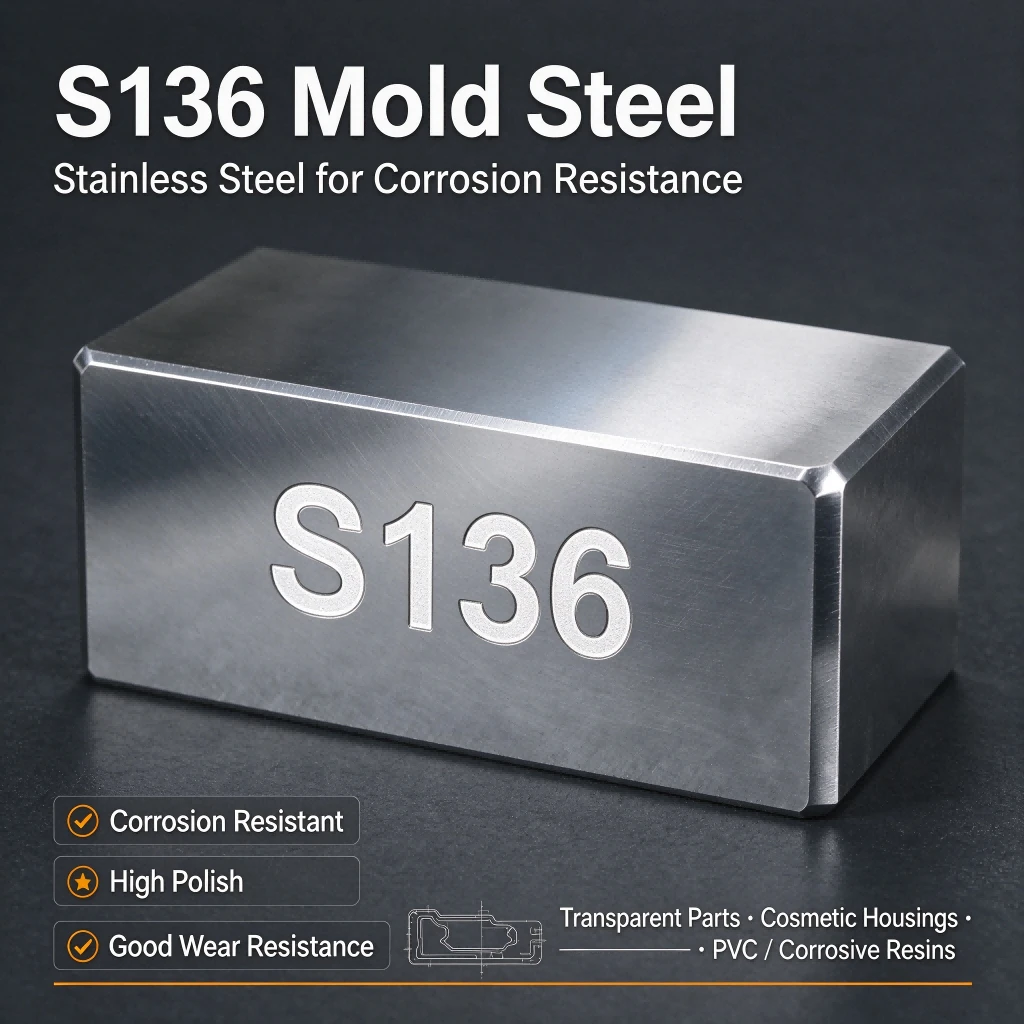
S136 is a stainless mold steel engineered for premium cavity surfaces and corrosion-resistant tooling.
Uddeholm Stavax ESR falls under this family (1.2083 / modified AISI 420). The manufacturer highlights its corrosion resistance, superior polishability and wear performance for transparent parts, medical containers and corrosive resins such as PVC and acetates.
Advantages
- Reliable corrosion resistance
- Exceptional polishability for cosmetic and optical finishes
- Preserves cavity surface quality over long production runs
- Reduces corrosion-related mold cleaning and repair
Typical applications:
- Transparent plastic components
- High-gloss cosmetic housings
- Optical molded parts
- Selected medical packaging containers
- Molds stored in humid environments or running corrosive resins
Limitations
S136 is not mandatory for every transparent or cosmetic part. Optical specification, steel purity, polishing process, resin chemistry and budget all need review before selection.
3. Quick Comparison: P20 vs. 718H vs. H13 vs. S136
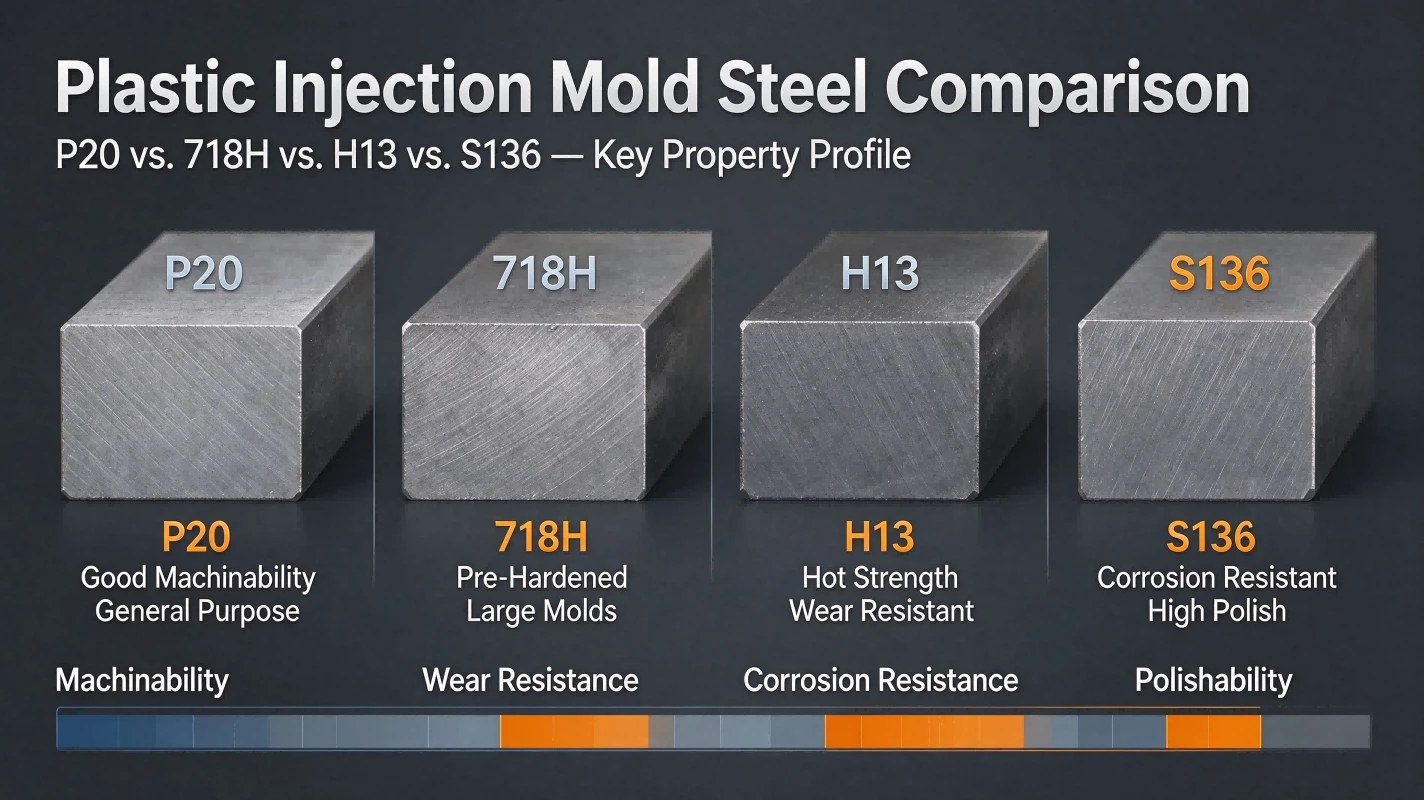
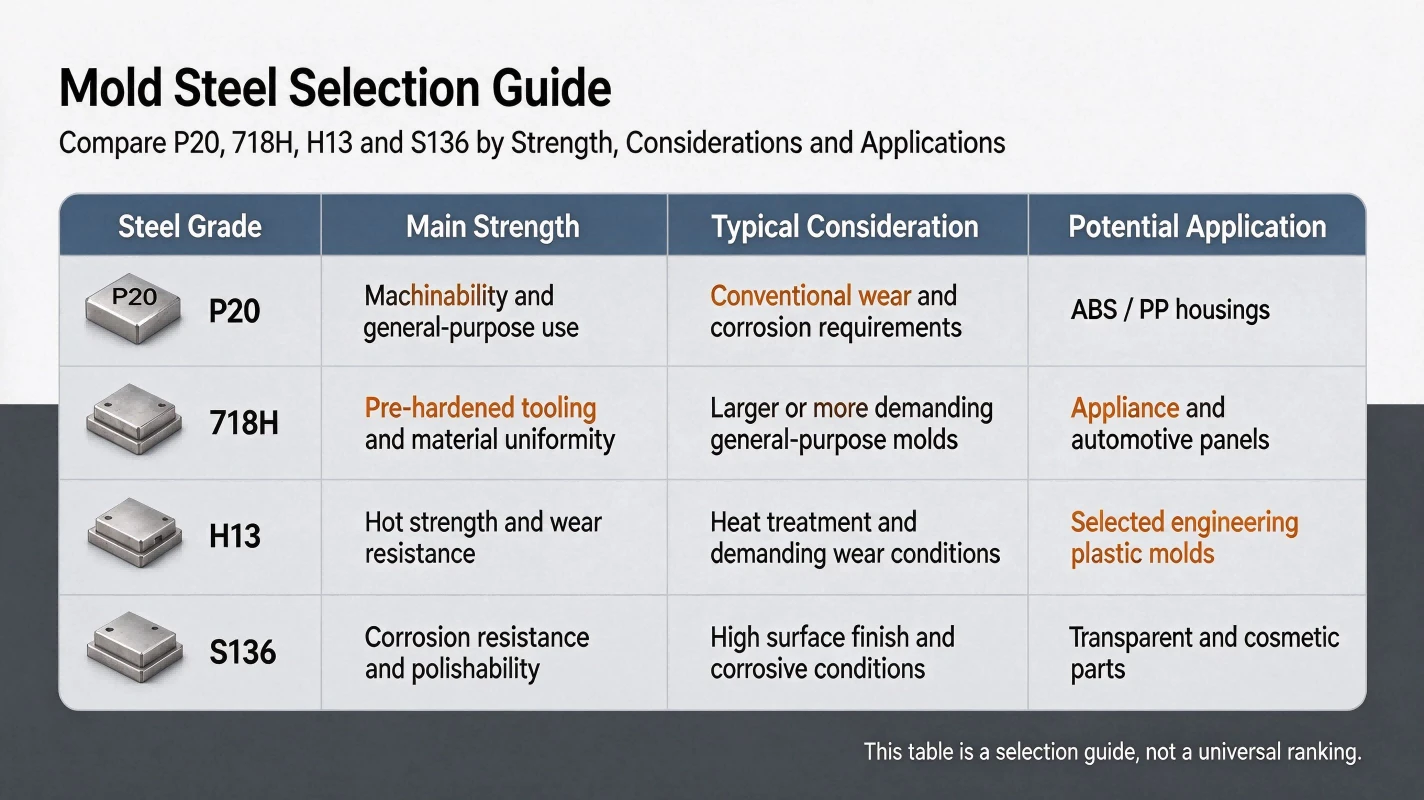
This table serves as a quick selection guide, not a rigid performance ranking. Real-world results depend on steel manufacturer, exact grade, delivery condition, heat treatment, mold design and maintenance schedule.
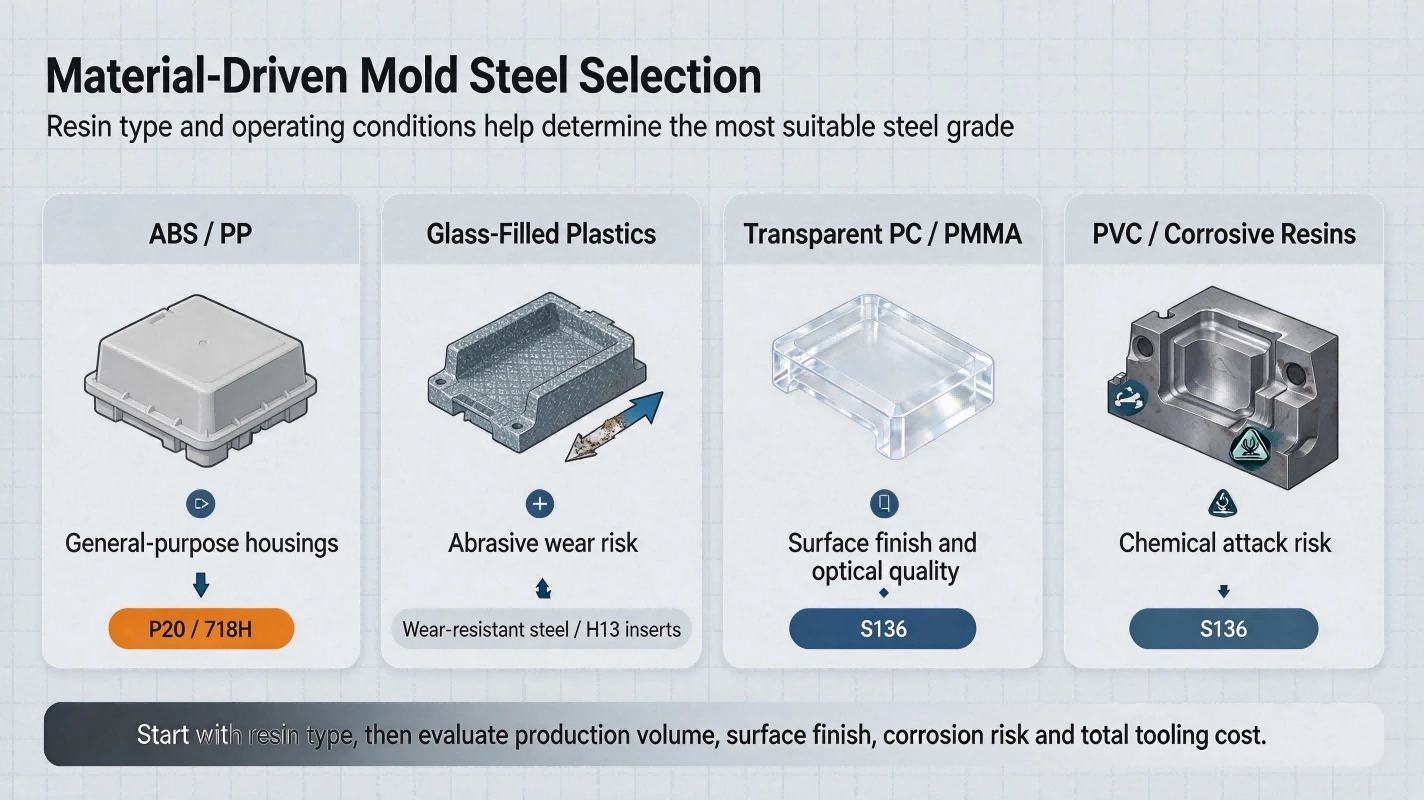
4. How Does Plastic Material Affect Mold Steel Selection?
The resin you mold is one of the first criteria to evaluate, as different plastics impose unique loads on mold surfaces.
5. Does Higher-Grade Mold Steel Always Mean a Better Mold?
Not at all.
A premium, expensive steel grade delivers no extra value if your project does not need its core properties.
Two practical examples illustrate this point:
Example A: General ABS enclosure
The part uses standard surface texture, medium output volume and faces no chemical corrosion risk. After DFM review, a cost-effective pre-hardened steel will perform adequately.
Example B: High-gloss transparent component
Mirror surface and consistent clarity are critical. Steel purity, polishability, corrosion resistance and polishing workflow become top priorities.
The best choice is not the most expensive steel, but the steel that meets your functional requirements without adding unnecessary cost.
6. Mold Steel Selection Should Consider the Total Cost
The upfront mold quote is only one slice of your tooling investment.
A simple way to compare two mold options is to calculate tooling cost per good part:

For illustration only:
- Mold A costs $10,000 and produces 200,000 accepted parts.
- Mold B costs $12,000 and produces 400,000 accepted parts.
| Item | Mold A | Mold B |
| Initial mold cost | $10,000 | $12,000 |
| Assumed accepted quantity | 200,000 | 400,000 |
| Tooling cost per part | $0.05 | $0.03 |
This calculation is for reference only; it does not guarantee mold lifespan or JIEJIN project results.
It excludes maintenance, repair, downtime and insert replacement. A full lifecycle cost analysis should include these extra production expenses.
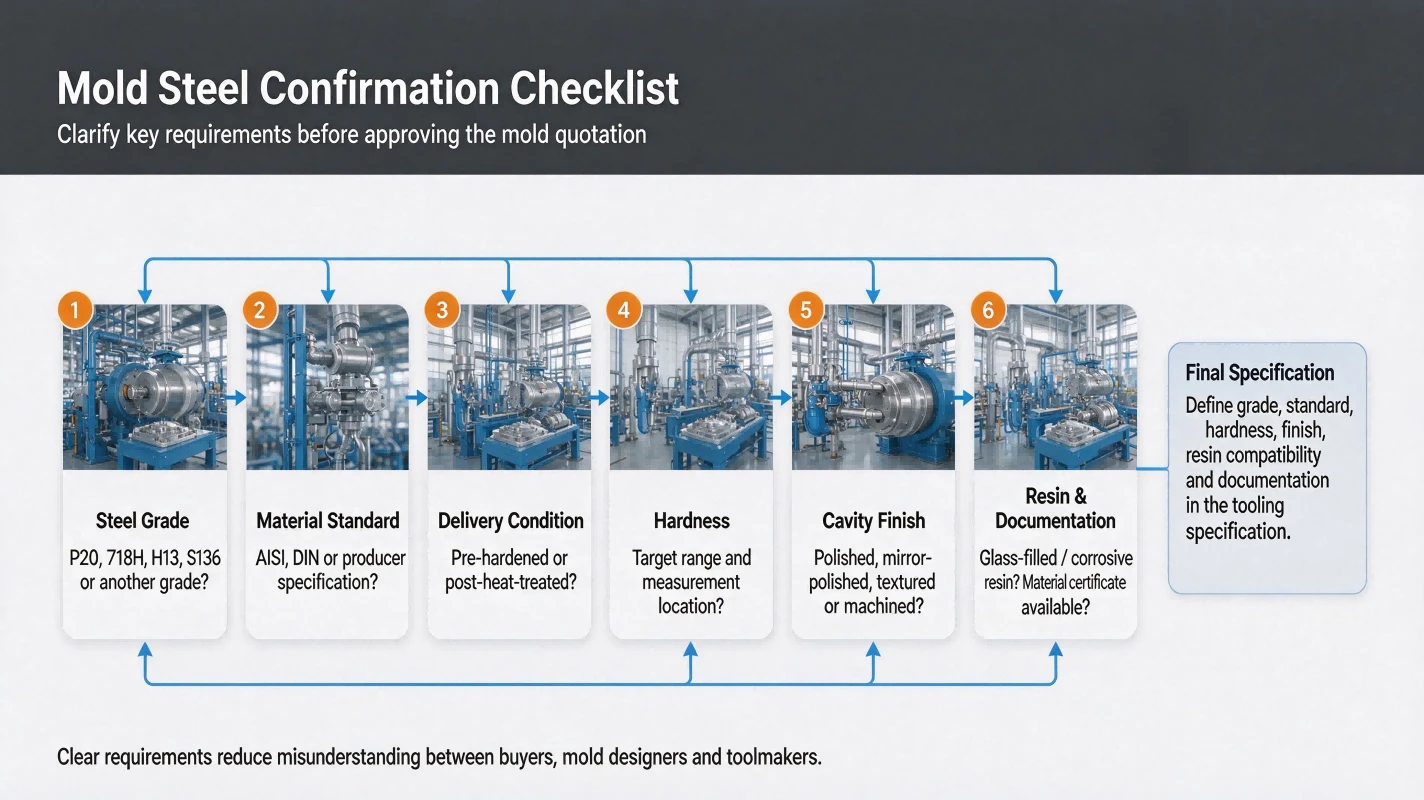
7. What Should Buyers Confirm Before Ordering a Mold?
Before approving a mold quotation, clarify these key details with your molder:
8. Mold Steel Options at JIEJIN PLASTIC
JIEJIN PLASTIC offers custom injection mold design and manufacturing, with steel options including P20, 718H, H13, S136, NAK80 and more, matched to project specifications.
Our engineering team reviews part geometry, resin choice, mold structure, surface finish requirement and production volume to define the optimal steel specification before machining starts. We avoid over-specifying steel just to match a quoted price.
If you are developing a new plastic part, share your 3D files, material specs and estimated production quantity with us.
Professional Engineering Team
Our mold engineers conduct thorough DFM reviews for every project. We balance material selection, mold structure, surface finish and cost to deliver reliable injection molds.
Responsive Technical Support
We provide timely quotation, DFM feedback and production updates. Send your 3D drawings and requirements, and our team will reply with tailored mold solutions quickly.

100+
Mold Projects Completed
15+
Mold Steel Grades Available
8000㎡
Factory Area
25+
Engineering & Production Staff
FAQ

Q1: What is the most commonly used steel for injection molds?
Q2: Is 718H better than P20?
Q3: Is H13 suitable for plastic injection molds?
Q4: Why is S136 used for transparent plastic molds?
Q5: Should buyers specify the mold steel in the purchase contract?



Looking for a Reliable Plastic Manufacturing Partner?
Manufacturing Solutions by JIEJIN PLASTIC
Plastic Injection Molding · Plastic Parts · 3D Printing · Packaging Solutions